-
-
Nowadays, it’s hard to find a place on the Internet that doesn’t have cats featuring somewhere – and Show Me is no exception! However, did you know that museums are also full of cats? You just need to know where to look…
Pincher the Mascot – Imperial War Museum, London
During the First World War cats were common pets and mascots, particularly on ships or in camps. They were useful because they kept the rats and mice populations down. Without these helpful felines living conditions for soldiers and sailors would have been pretty miserable.
The cat pictured below was called Pincher, the mascot of HMS Vindex. Here you can see him perched on top of the propeller of a Sopwith Camel fighter plane carried by the ship.Girl with cat on table, Arnoud Schaepkens, 1831 – 1904 – Rijksmuseum, Amsterdam 'Pincher', the mascot of HMS VINDEX.© IWM
Have you ever tried to sit down and concentrate on something only to be interrupted by an affectionate feline? Can you imagine how the girl from this etching might feel?Mummified Cat – Wellcome Collection, London © Science Museum, London, Wellcome Images
Throughout history, it’s clear that people loved their cats but not everyone loved them as much as the Ancient Egyptians. Cats were considered to be sacred and connected to the cat-headed goddess of fertility, Bastet.
In fact, cats were so highly thought of that they were often mummified in a similar way to humans. They were normally placed in a sitting position and wrapped tightly with cloth painted with feline features.If you want to know more about mummified cats, the Natural History Museum has a video which shows a CT scan of a mummified cat, revealing its secrets. © Science Museum, London, Wellcome Images
Gayer-Anderson Cat – British Museum, London
We weren’t kidding when we said the Egyptians loved their cats! This sculpture of a cat is called the Gayer-Anderson cat after the name of the person who donated it to the museum.
There were many sculptures of cats made by the Egyptians, but this is a particularly beautiful example, with its gold rings, silver collar and a protective amulet in the shape of an eye. This is known as wedjet amulet.The tone artists, Henriëtte Ronner, 1876 – 1877 – Rijksmuseum, Amsterdam © Jack Shoulder
Some people say that cats are always out of tune, and if you’ve ever heard a cat sing then you would probably agree with them. It’s almost certainly a good thing that these cats are branching out musically and exploring the guitar. Watercolour by Henriëtte Ronner© Rijksmuseum
Skull of a sabre-toothed cat – Natural History Museum
As much as we love cats, we’re rather glad that this one is now extinct! The Smilodon, or sabre-toothed cat, was a vicious predator, which could grow as big as a lion. As you can see from the image below, this animal had huge teeth that it used to stab the flesh of its prey.Have you ever heard a rumour that there are mysterious large animals roaming across Britain? There have been lots of stories but no physical evidence until a young boy discovered a skull rather like the one above on Bodmin Moor in Cornwall. Find out more about “The Beast of Bodmin Moor” with this interactive from the Natural History Museum. © The Trustees of the Natural History Museum, London
Tipu’s (or Tippo's) Tiger – V&A, London
This amazing wooden life-sized sculpture of a cat attacking a European man made of carved and painted wood has a hidden secret. Concealed inside is a mechanical pipe-organ!When you turn one handle, air is pumped into a pair of bellows, creating a sound that simulates the victim's cries and the tigers growls. Another handle supplies air for a miniature organ. You can see the organ in action in this video from the V&A. 'Tipu's Tiger' (detail showing organ), 1790, V&A© Courtesy Victoria and Albert Museum, London
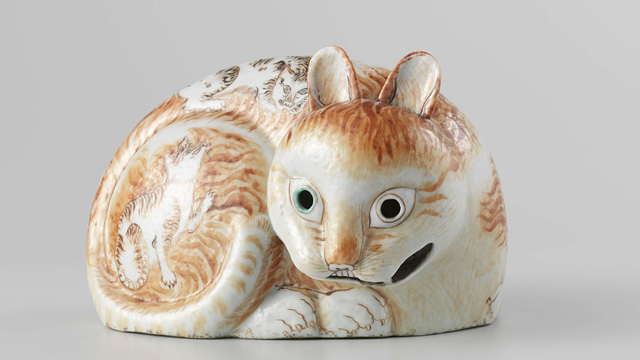
Cat Nightlight – Rijksmuseum, Amsterdam, Netherlands
Like real cats, this cat also used to scare off rats. When a candle is placed inside this porcelain figure, the light shines through its eyes. As well as scaring off unwanted mice or rats, the light was also a comfort for children afraid of the dark.Cats at the Hermitage, St Petersburg Nightlight in the form of a cat, Anonymous© Rijksmuseum
For some museums, having works of art or the remains of cats simply isn’t enough – only the real thing will do. The Hermitage at St Petersburg in Russia used to be a royal palace but is now one of the largest and oldest museums in the world. It’s also possibly the museum with the largest population of cats.
In 1745 the Empress Elizabeth ordered that cats were to be brought to her court in Moscow to keep the rat and mouse population in check. Cat have lived at the Hermitage more or less continuously ever since. There are now over 60 cats living in the museum basement.
Find out more about these special museum employees in the video below.
Kittens getting married
Have you ever heard of Walter Potter? He was a famous taxidermist who made scenes with animals doing some very human things like going to school and getting married. One of his most famous pieces is called The Kittens’ Wedding and you can see it in this film. We can’t decide if it is cute or a bit creepy.
Want to see more? Well, there’s an entire museum devoted to cats in Amsterdam. It’s called De Kattenkabinet – or The Cat Cabinet in English – and it’s filled with all kinds of catty objects, from posters to sculptures to photographs and paintings. You can go on a virtual tour of it here.
-
Nowadays, it’s hard to find a place on the Internet that doesn’t have cats featuring somewhere – and Show Me is no exception! However, did you know that museums are also full of cats? You just need to know where to look…
Close