Collection object HistoryScience
Bottle of blood purifying mixture
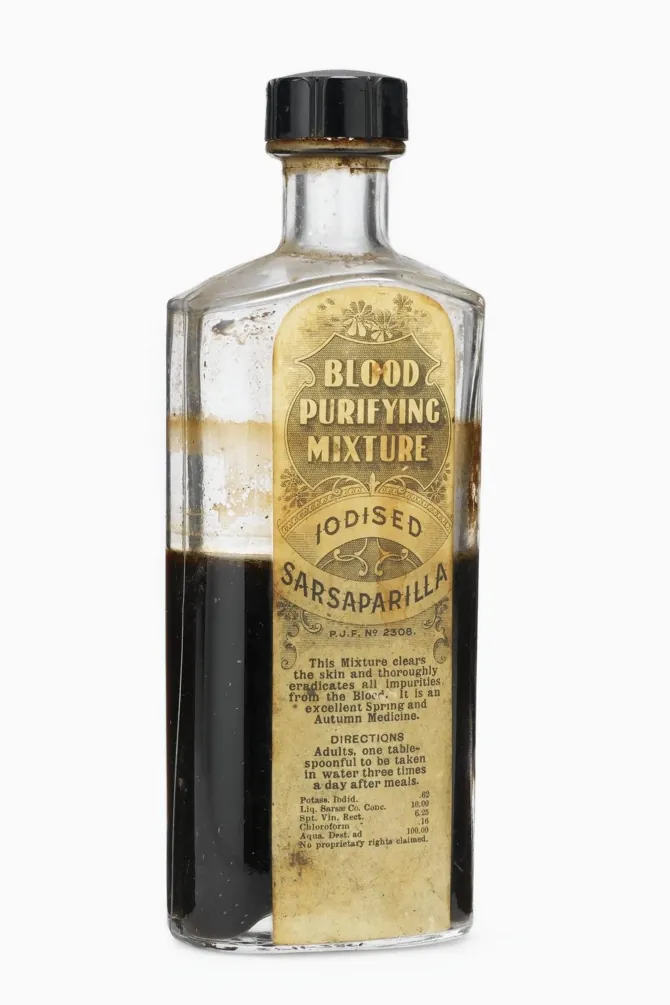
When you look at this bottle of Blood Purifying Mixture it is hard to believe that this was used as medicine, it looks more like something a vampire might keep in his kitchen.
The main ingredient, Sarsaparilla, comes from the Americas and would have been brought to Europe in the 16th century. At this time people would sill have believed in the ideas of Galenic medicine – the system of medicine first thought of by Galen, a doctor from ancient Greece.
Galenic medicine is based on the idea that the body is made up of four substances or humours. Each of these humours needs to be in balance for the body to remain well. When the humours come out of balance a person would become ill.
The humours were closely related to parts of the body, people’s moods and even the seasons. This blood purifying mixture was advertised as an “excellent Spring and Autumn medicine”.
By the 19th Century, when this mixture was made, people were beginning to move away from these old ideas about medicine. However the association of the medicine to the seasons shows that people still thought these things were linked.
Museum’s description
Sarsaparilla is a plant found in North America and the West Indies, it has long been used as an ingredient in medicinal tonics, like this blood purifier. You would have been available to buy this product ‘over the counter’ in many pharmacies at the time. The instructions recommend that adults take 1 tablespoon mixed with water, 3 times a day after meals. The mixture promises to give you clear skin and purify your blood, it also claims to be an “excellent Spring and Autumn medicine”.
Teacher notes
Belief in the Humoral theory of medicine was incredibly long-lasting and still has influences on how we understand health and medicine today.
The Science Museum has a great website dedicated to the history of medicine. The website is actually aimed at GCSE students however the information they provide could be easily translated into a KS 2-3 lesson.
They have a whole section dedicated to understanding Humoral medicine.
Additionally, Worcester Medical Museums have a load of great resources for teachers and students about the history of medicine.
Teachers can also visit the Science Museum Group learning resources website.This website brings together learning resources from the four Museums in the Science Museum Group, including activities, games and videos. Browse all the resources and discover activities to support a range of curriculum topics for use in the classroom, in museum galleries and beyond.
You might also like

Video from English Heritage
How to diagnose illness in the 15th Century
English Heritage show us just how far medicine has come. This video shows you how a doctor in the 15th Century would go…

Object from Science Museum
Electroconvulsive therapy machine
This is a very strange looking machine, it looks like part of an aeroplane or boat, certainly not something that would be…

Top ten
Top ten British Pathe films
British Pathé is one of the oldest media companies in the world, with a history stretching back to the 1890s. In that time…

Video from British Pathé
A 1920s Music Player
Check out this 1920s predecessor to the Walkman and iPod. Fantastic film showing the forerunner of the Sony Walkman - tuning…